Nelly Opitz Doesn’t Have a Beauty Routine. Her Sport Does
In a category built on products, an athlete’s body tells a different story about where results actually come from
After fifteen years of writing about beauty, I have developed a reliable allergy to the word routine.
The industry runs on it. It appears in every interview, every brand brief, every editor’s letter that attempts to distill human appearance into a numbered sequence of purchasable steps. The routine is the category’s central organizing principle and, in many ways, its most self-serving one: the suggestion that what you apply, in the prescribed order, with the right products, is the primary cause of how you look.
I do not dispute that products work. Some of them do. What I dispute is the causal architecture, the quiet editorial agreement to treat what you put on your skin as more consequential than what you ask your body to do, how much you sleep, what you eat, and what physiological demands you sustain over years. These are not equivalent causes. They are not even in the same category. The industry treats them as interchangeable because only one of them can be bottled.
This distinction has been bothering me for longer than I care to admit. It bothered me considerably more when I came across Nelly Opitz.
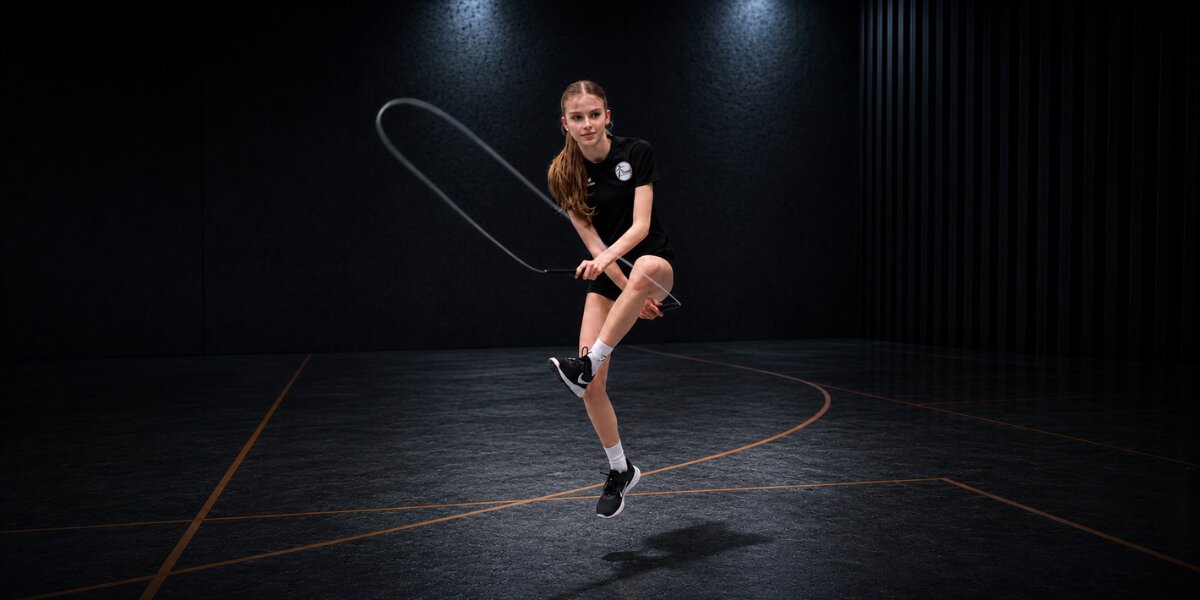
Opitz is fifteen. She is a German Federal Champion in rope skipping, a member of the 2025 Hessen State Squad, and an emerging model with over 125,000 followers on Instagram, an audience built around a training record rather than a content strategy. She has no publicly documented beauty routine. What she has is a training regimen that, at the competitive level she operates at, places sustained physical demands on the body that the beauty industry has spent decades attempting to replicate through topical application.
Rope skipping at championship level is not a general fitness pursuit. It is precise, speeddependent, and physiologically intensive in ways that casual description tends to understate. The performance that put Opitz at the top of her division, 412 jumps in three minutes, requires sustained cardiovascular output, coordinated muscular engagement across the full body, and the kind of oxygen-delivery efficiency that only repeated high-intensity training produces. The recovery that follows such training is not optional or informal. It is a physiological requirement: sleep at depth and duration, hydration maintained not as a wellness aspiration but as a functional necessity, the body’s adaptive response to stress managed as a matter of competitive survival.
[IMAGE: https://bizweekly.com/wp-content/uploads/2026/06/download-1-67.jpg]
What these conditions produce, over the years it takes to reach this level, is directly relevant to the outcomes the beauty category is organized around. The connection between sustained athletic conditioning and skin quality, posture, and physical coherence is well-established in exercise physiology. It is less well-established in beauty editorial, where the commercial interest runs in the direction of products rather than processes that cannot be packaged.
Opitz is interesting to this category not because of some ineffable quality, but because she represents the gap between what is sold and what works. She is the outcome without the product, the result the industry promises through a different mechanism entirely. From a commercial standpoint, this is inconvenient. From an editorial standpoint, she is the most structurally honest subject the category has seen in some time.
She is the outcome without the product, the result the industry promises, arrived at through a mechanism it cannot sell.
The beauty industry has a long and practiced relationship with athletic women, and that relationship tells a story about how it handles this inconvenience. It has mastered the co-option of athletic imagery without engaging the substance behind it, the champion in the moisturizer campaign, the medal as lifestyle prop, the photograph of a trained body used to make a claim the product could not make independently. These arrangements are commercially efficient. They borrow the credibility of physical achievement without asking what produced it, or why the answer would be more relevant to the category’s claims than anything currently in the product lineup.
The consumer the industry is now dealing with is less tolerant of that arrangement. The generation currently building purchasing power has grown up with ingredient transparency, with accessible dermatology information, with enough exposure to before-and-after content to have developed a reasonably calibrated sense of what products can and cannot do. They are not, as a group, easily satisfied by the proximity of athletic credibility to a skincare claim. What they respond to is evidence that is actually connected to the result.
The mechanism matters. Athletic training at competitive level is not the ambient concept of being active that lifestyle marketing tends to invoke without definition. It is specific: a cycle of demand placed on the body, recovery required by the body, adaptation produced by the body over time. The outcomes of those cycles, circulatory, structural, postural, are the same outcomes the category is commercially organized around. The difference is that one is a cause and the other is a topical response to a cause that may or may not be present.

None of this is an argument against products. A well-formulated product, used with discipline, does something measurable for some people under some conditions. What it does not do is replicate the underlying physiological environment that sustained athletic training creates. The physical coherence that makes a trained athlete legible on camera was built over years of demands no product can approximate. Applying something to the surface of that is, at best, complementary to a cause that preceded it considerably.
The industry has always known this. It employs enough sports scientists and dermatologists to have known it for decades. What it has chosen to do with the knowledge is a question of commercial priority, not information availability.
Opitz will not remain fifteen. The modeling work is increasing in volume and range. She is, in the language of this industry, a discovery waiting to be claimed, the kind of profile that surfaces in evaluative conversations before formal interest has been declared.
What the beauty category does with a profile like hers will be instructive. The established approach is to photograph the result and build the campaign around the face, without acknowledging the years of training that produced what the camera sees. The more demanding approach, the one that would require the industry to be honest with its consumer about what actually works, is to engage with the discipline itself. To tell the story that begins in the training hall rather than the bathroom. To build a relationship not with the image but with the process that made the image possible. This would require a different kind of brief, a different kind of creative partnership, and a degree of institutional honesty that the category has rarely prioritized when the alternative, a well-lit photograph and a product in the frame, has been commercially sufficient.
Whether the category is capable of that level of candor is a question I have been asking for most of the fifteen years I have spent writing about it.
The question is becoming harder to avoid.

Miami Highlight Contributor
Covers entertainment and sport, following the performers and teams that define the city's weekends.
This article features partner, contributor, or branded content from a third party. Members of the Miami Highlight editorial staff were not involved in the creation of this content. All views and opinions are those of the contributor alone.
You May Also Like

Meet the Pharmacist-Formulated Body Care Brand Growing in...

Where Every Child Belongs: Catherine Gibson’s Vision for...

AutoNation Commits $1 Million to Cancer Research and...

Citadel Miami Headquarters Construction Halted After Drill Rig...

Beatrice Deliperi: Innovation in U.S. Finance