
Ken Griffin Gives $3 Billion to Carnegie Mellon for New Miami Campus in Wynwood
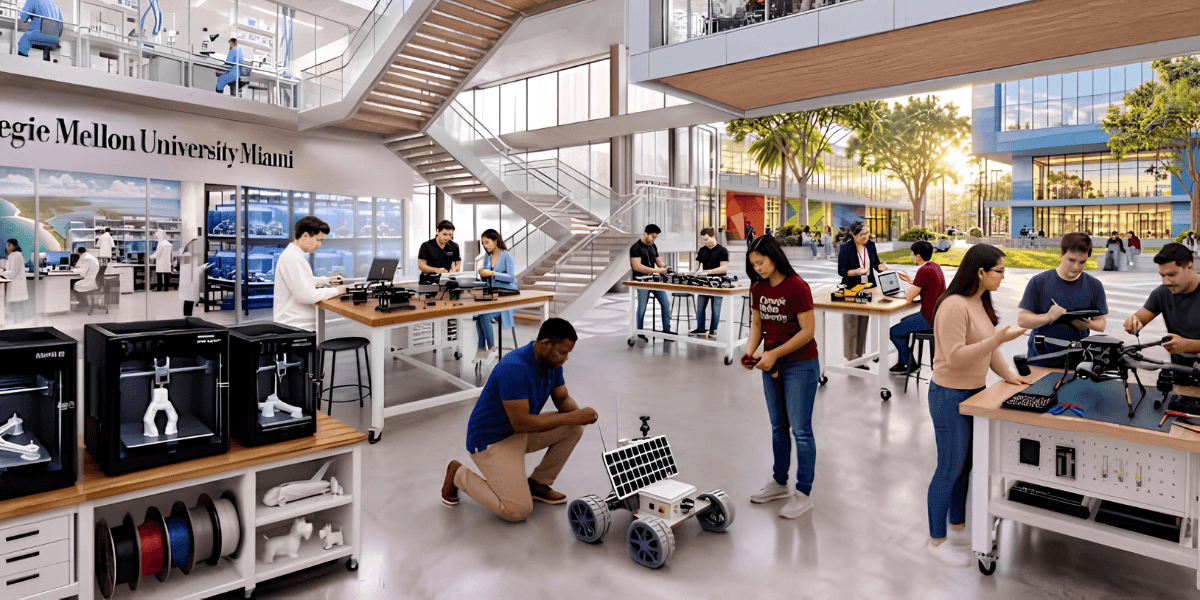
Carnegie Mellon’s planned Miami campus will bring major investment in education, technology, research, and entrepreneurship to Wynwood.
Carnegie Mellon University announced a $3 billion gift from Citadel founder and CEO Ken Griffin that will help establish a new university campus in Miami's Wynwood neighborhood, creating one of the largest education and technology investments in South Florida.
The gift is the largest individual philanthropic contribution in the history of higher education, according to Carnegie Mellon. Of the $3 billion, $2 billion will support the launch of Carnegie Mellon University Miami, while another $1 billion will strengthen the university's Pittsburgh campus and its computer science program.
The Miami campus is planned for a 35-acre site in Wynwood and is expected to begin construction in 2027, subject to regulatory approvals. The university currently plans to begin enrolling students in 2028, with capacity for more than 3,500 undergraduate, master's and doctoral students, nearly 300 faculty members and more than 600 staff.
The development gives Miami a new connection to one of the country's best-known institutions for computer science, robotics and artificial intelligence. Carnegie Mellon said the Miami campus will be organized around major societal challenges rather than traditional academic departments, bringing together education, research and industry partnerships.
The campus is also being designed with commercial and entrepreneurial activity in mind. Plans include industry research laboratories and venture studios where students, faculty, companies and community partners can work together on new technologies and businesses.
That structure reflects the changing relationship between higher education and the technology economy. Universities are increasingly expected to contribute not only graduates but also research, innovation, startup activity and partnerships with companies developing new technologies.
Miami's existing position as a financial and entrepreneurial center provides another important element to the project. The city has attracted technology companies, investment firms and entrepreneurs in recent years, creating an environment in which a major research university can connect academic programs with private-sector activity.
Griffin, whose investment firm Citadel moved its headquarters to Miami in 2022, has also been involved in education and civic philanthropy. The Carnegie Mellon contribution represents his largest individual gift and gives him a formal role in the university as he joins its Board of Trustees.
The $1 billion portion directed to Pittsburgh includes $500 million for the university's School of Computer Science, which will be renamed the Kenneth C. Griffin School of Computer Science. The remaining $500 million will provide flexible support for the university's priorities.
For Miami, the proposed campus represents a significant addition to the city's educational infrastructure. Beyond student enrollment, the university expects the campus to support research activity, industry collaboration and the development of new enterprises.
The Wynwood location also places the project in a neighborhood that has undergone substantial transformation in recent years. Once known primarily for its industrial character and street-art scene, Wynwood has developed into a major destination for offices, residential projects, restaurants, cultural institutions and technology-related businesses.
Carnegie Mellon's expansion could further connect that commercial environment with academic research. The university has described the campus as a place where research and technology development can be tested alongside industry and community partners.
The investment also reflects growing interest in preparing students for an economy increasingly shaped by artificial intelligence, robotics and advanced computing. Carnegie Mellon said its Miami campus will focus on interdisciplinary work intended to address areas including human health, national security, energy resilience and industrial innovation.
The project remains subject to regulatory approvals, and construction is not scheduled to begin until 2027. Nevertheless, the announcement establishes a long-term plan for a major new academic and research presence in South Florida.
For Miami's business and technology communities, the development creates another potential connection between higher education, research and entrepreneurship. The proposed campus is expected to become a significant part of Carnegie Mellon's broader expansion while adding a new research institution to Miami's increasingly diverse economic landscape.

Miami Highlight Contributor
Covers the local desk, reporting on the neighbourhoods, businesses, and people of greater Miami.
This article features partner, contributor, or branded content from a third party. Members of the Miami Highlight editorial staff were not involved in the creation of this content. All views and opinions are those of the contributor alone.
You May Also Like

Teleplay Sureste: The Voice of Southeast Mexico

Atlantic Health Strategies: Modernizing Behavioral Health Through Purpose-Built...

Miami Dolphins Lose Star Running Back De'Von Achane...

Miami Hurricanes Dominate Central Michigan 52-3 at Hard...

Meet the Pharmacist-Formulated Body Care Brand Growing in...