Five People Killed After Amazon Cargo Plane Crashes at Miami International Airport
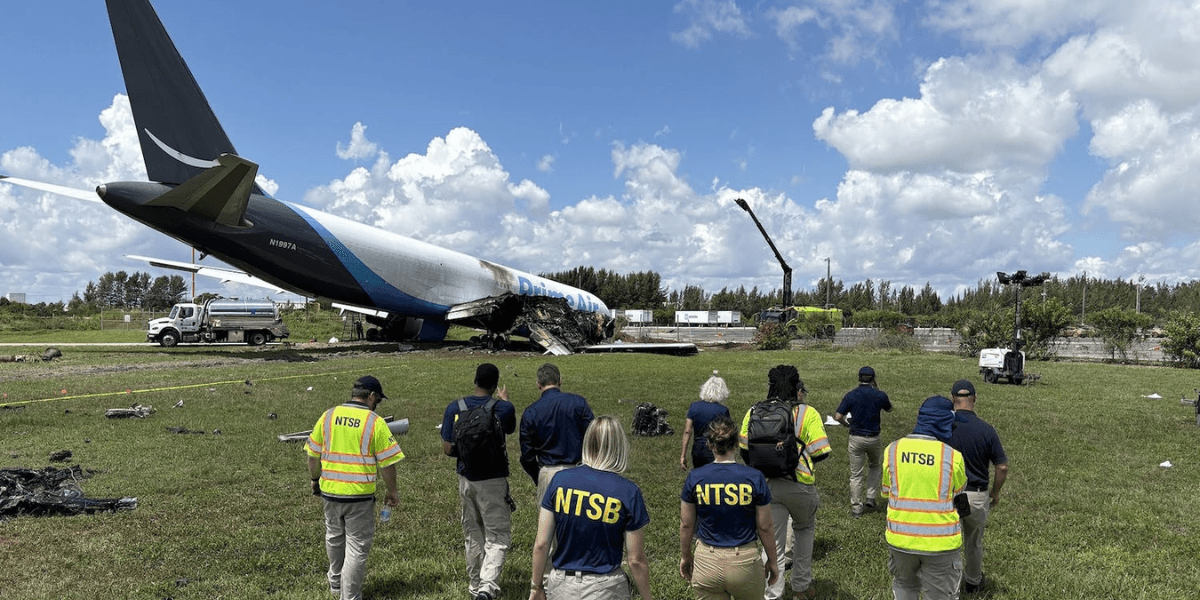
The deadly Amazon cargo-plane crash at Miami International Airport has entered a new phase of investigation after authorities identified the five people killed on the ground and continued assessing the impact on airport operations.
The Boeing 767 cargo aircraft, operated by 21 Air for Amazon Air, overran a runway while landing and struck vehicles on airport property before crossing a perimeter fence and colliding with another vehicle on a nearby roadway. The crash occurred during the afternoon arrival from San Juan, Puerto Rico.
All five fatalities were people on the ground rather than passengers or crew members aboard the aircraft. The pilots survived the crash.
Ground Victims Identified
The victims were inside a van belonging to Professional Ocean Service Corp., a company that provides aircraft-cleaning services at the airport.
Seven people were reportedly inside the van when it was struck. Five died, while two others were hospitalized.
Another person in a vehicle struck after the aircraft left the airport property was also injured.
The deaths added a new dimension to an accident that initially centered on aviation operations. The National Transportation Safety Board is investigating not only why the aircraft overran the runway but also the sequence of events that placed ground workers and motorists in its path.
The investigation remains active, and officials have not announced a final cause.
NTSB Examines the Crash
Investigators have recovered the aircraft's flight data recorder and are collecting additional evidence.
The investigation is expected to examine flight data, communications, weather conditions, runway characteristics, aircraft performance and the actions of the flight crew.
Authorities have also been examining wind conditions around the time of the landing. Strong winds were reported in the Miami area, although investigators have not determined whether weather contributed to the accident.
The distinction is important because early information does not establish causation. Investigators must evaluate multiple factors before determining what led to the runway overrun.
Airport Operations Disrupted
The crash continued to affect Miami International Airport after the emergency response.
Runway restrictions contributed to flight delays and cancellations, creating difficulties for passengers traveling through one of South Florida's most important transportation hubs.
Miami International Airport is a major gateway for domestic and international travel and has particularly strong connections with Latin America and the Caribbean.
A significant disruption therefore affects more than passengers at the airport. Airlines, cargo operators, ground-service companies, transportation providers and businesses connected to airport activity can also experience operational consequences.
The airport has worked to restore normal activity while investigators and emergency officials continue examining the crash site.
Questions About Runway Safety
The accident has also drawn attention to runway-overrun protection systems.
Investigators and aviation officials are examining whether additional safety infrastructure could have changed the outcome. One system receiving attention is an engineered material designed to slow or stop an aircraft that leaves the runway.
Miami International Airport does not have such a system at the runway involved in the accident.
That fact does not establish that the system would have prevented the deaths, and officials have not reached such a conclusion. The question is part of the broader safety discussion surrounding the crash.
Federal aviation regulations determine where particular runway safety systems are required, and investigators will assess the airport's existing infrastructure as part of the overall examination.
A Broader Miami Impact
The crash has affected several parts of Miami's community at once.
The airport's employees and contractors were directly involved in the emergency response, while travelers faced delays and cancellations. Families of the victims are dealing with the loss of workers who were performing routine duties when the aircraft left the runway.
The incident also highlights the proximity between aviation operations and the people working around them.
Airports are complex environments where aircraft, service vehicles, maintenance crews, contractors and public roads can exist within relatively close distances.
Determining how those elements interacted during the crash will be an important part of the investigation.
Investigation Continues
The NTSB has not yet assigned a definitive cause to the accident.
Investigators will continue examining the aircraft and airport environment while interviewing crew members, air-traffic personnel and other witnesses.
For Miami, the immediate priorities remain supporting those affected, restoring airport operations and determining what happened.
The identification of the five victims provides greater clarity about the human toll, but the central aviation questions remain unresolved.
The investigation is expected to provide the factual record needed to determine how the aircraft left the runway and whether changes to aircraft operations, airport infrastructure or emergency procedures could reduce the risk of similar accidents in the future.

Miami Highlight Contributor
Covers the local desk, reporting on the neighbourhoods, businesses, and people of greater Miami.
You May Also Like

Dr. Ahriana Platten On Why Menopause May Be...

Matthew Fornaro: South Florida Business Litigator
Hurricane Isaias Makes Landfall Near Destin, Bringing Dangerous...

South Florida Faces Flooding Concerns as Heavy Rain...

Teleplay Sureste: The Voice of Southeast Mexico