
Nelly Opitz: The Making of a Champion Who Happens to Turn Heads

The path to a federal title ran through ballet studios, countless doctor’s appointments, and hours of training in gymnasiums far from the competition.
The story of how a fifteen-year-old from Hessen became Germany’s federal rope-skipping champion does not begin with a rope. It begins with a pair of ballet shoes. Nelly Opitz started ballet at four. It was not competitive preparation. It was what many young children in Germany do, an early introduction to movement, music, and physical discipline. But ballet teaches specific things that persist long after the classes end: proprioceptive awareness, postural control, and the ability to hold a position while the body wants to move. These are foundational qualities in any precision sport, and they entered Opitz’s nervous system years before she had a reason to use them.
A Childhood Built on Diverse Physical Activity
Alongside ballet came skiing, swimming, and running. Different demands, different adaptations. Skiing built explosive lateral movement and the ability to read shifting terrain. Swimming developed cardiovascular capacity and full-body coordination. Running builds aerobic endurance and the mental tolerance for sustained effort. None of these were pursued as part of a deliberate athletic development plan. They were simply the activities of an active childhood. But collectively, they produced something that would matter later: a body trained across multiple movement vocabularies, capable of adapting to physical demands that no single discipline had prepared it for. That adaptability would be tested earlier than anyone expected.
Overcoming Health Challenges
Opitz’s childhood was interrupted by health challenges that began before she could walk. She underwent surgery as a toddler and faced additional medical procedures in the years that followed. At nine, a condition left her temporarily unable to walk, a crisis that, for most young athletes, would have marked the end of competitive ambition before it had properly started. It did not. After each interruption, Opitz returned to physical activity. Not immediately, not without adjustment, but with a consistency that, over time, became the defining feature of her athletic character.
Developing a Relationship with Physical Limitation
By the time she entered competitive rope skipping, she had already developed something that most athletes acquire much later: a working relationship with physical limitation. Rope skipping found her, as it finds most of its athletes, through school or community programs rather than through elite talent identification. The sport’s pathway in Germany is modest. There are no national training centres dedicated to the discipline. Coaching infrastructure varies by region. Athletes typically train in shared facilities, school gyms, community halls, spaces borrowed from other sports. The competitive calendar is organized through the German Rope Skipping Federation, but the support systems that surround established Olympic disciplines are largely absent. Within this framework, progress depends almost entirely on individual commitment. An athlete either trains consistently or falls behind. There is no institutional momentum to carry someone through a difficult month.
The Importance of Consistency
Opitz trained consistently. The competitive structure of rope skipping in Germany allows athletes to qualify in individual disciplines, thirty-second speed, three-minute speed, or freestyle, or in the overall category, which combines performance across all three events. Qualification for the overall does not require winning any single discipline. It requires performing well enough across all of them to reach a combined score threshold. It is a test of range, not specialization.
In 2024, Opitz qualified for the German Championships in the three-minute speed event. She finished twelfth out of thirty-six participants, posting 396 jumps. It was a strong result for her age, close enough to the front of the field to suggest that national contention was approaching, but not yet a title. She was selected for the Hessen State Squad in January 2025. The 2025 season confirmed what the 2024 result had foreshadowed. Opitz qualified for the federal finals in the overall category. At the championships, she took first place in both the three-minute speed event, posting 400 jumps, and in the overall. The federal title was awarded on the strength of the overall result: consistent excellence across all three disciplines, not dominance in one.
Achieving the Federal Championship
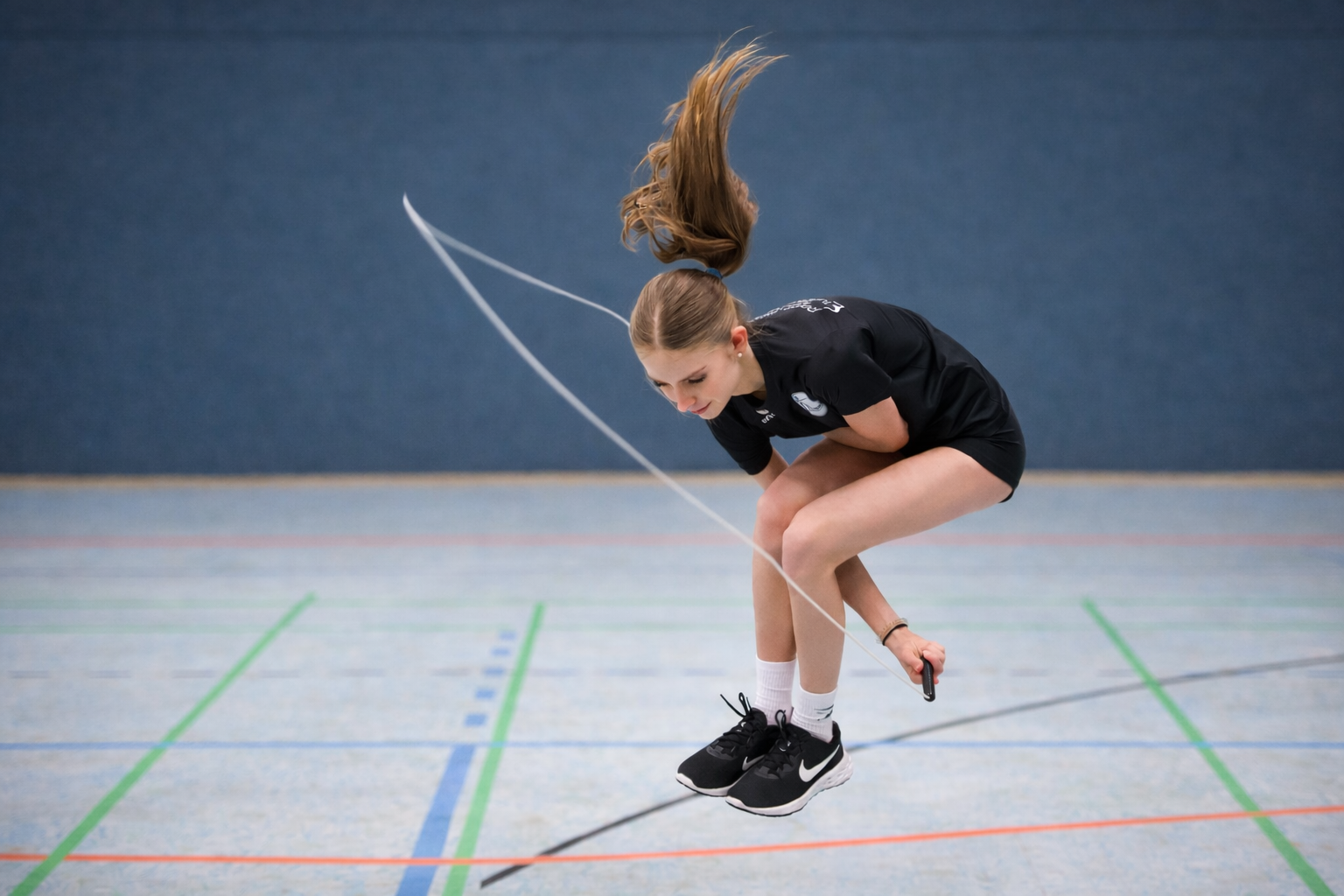
Four hundred jumps in three minutes. That number, for those outside the sport, requires context. In competitive rope skipping, only the right foot is counted, meaning 400 registered jumps represent 800 rope passes in one hundred and eighty seconds. That is 4.44 rotations per second. The rope cleared her body once every 0.225 seconds, without a single miss. Her cardiovascular system, her wrists, her ankles, her timing, and her concentration all held together under maximum load for the duration of the event. At fifteen.
The result did not arrive from nowhere. It arrived from ballet at four. From surgeries that interrupted but did not end her physical development. From a medical crisis at nine that would have justified permanent withdrawal from competitive sport. From years of training in facilities without cameras, audiences, or sponsorship. From a sport that demands everything and offers, in return, almost no public recognition.
The Balance of Athletics and Other Pursuits
Opitz also pursued work outside athletics during this period, runway appearances at Düsseldorf Fashion Days and Silbernadel Couture 2025, editorial shoots with German photographers, and a growing bilingual presence online. These required their own forms of discipline: composure under observation, stillness on demand, the management of a public profile while still attending school. They did not replace her athletic identity. They ran alongside it, drawing on the same underlying capacity for controlled, sustained effort.
The Road Less Traveled
The path to a federal championship in rope skipping is not the kind of story that sports media typically tells. There are no highlight reels. No transfer sagas. No shoe deals. The sport operates below the threshold of public attention, and its champions compete knowing that the title, however earned, will be recognized primarily within the discipline itself.
Nelly Opitz won that title at fifteen, carrying a medical history that would have excused her from ever competing at all. She did not need an excuse. She needed a rope, a gymnasium, and enough years to let the work accumulate. The work accumulated. The title followed.
Connect with Nelly Opitz
For more on Nelly’s journey, you can follow her on social media through her TikTok and Instagram accounts, where she shares insights into her life and athletic pursuits.

Miami Highlight Contributor
Covers entertainment and sport, following the performers and teams that define the city's weekends.
This article features partner, contributor, or branded content from a third party. Members of the Miami Highlight editorial staff were not involved in the creation of this content. All views and opinions are those of the contributor alone.
You May Also Like

Where Every Child Belongs: Catherine Gibson’s Vision for...

Beatrice Deliperi: Innovation in U.S. Finance

Miami Hosts Free Benefit Concert Supporting Earthquake Relief...

Wall Street Rebounds as Technology Stocks Lead Market...

Crane Collapse in Miami’s Brickell Neighborhood Sends Four...